
If you’ve been researching a chest freezer cold plunge in Australia, you’ve probably seen hundreds of YouTube videos showing chest freezers turned into ice baths for under $1,500. It looks straightforward — buy a freezer, waterproof it, add a temperature controller, and you’re done.
But there’s a reason people keep asking whether chest freezer cold plunge conversions actually work long-term, or whether a purpose-built system is worth the extra cost. Whether you’re searching for a chest freezer ice bath or a purpose-built cold plunge, I researched both approaches extensively before building a purpose-built insulated system and tracking its performance over 6+ months of daily use in Newcastle, NSW.
Here’s what you need to know about chest freezer cold plunge options in Australia versus purpose-built insulated systems.
What Is a Chest Freezer Cold Plunge Conversion?
A chest freezer conversion takes a standard deep chest freezer (typically 400–500L capacity) and repurposes it as a cold plunge. The freezer’s compressor maintains water temperature, and you add waterproofing to protect the interior from corrosion.
The basic conversion process:
- Purchase a large chest freezer ($600–$900 AUD)
- Waterproof the interior with marine-grade sealant or pond liner
- Install an external temperature controller (freezers run too cold without modification)
- Add basic filtration or water treatment
- Fill with water and adjust temperature to 10–15°C
The appeal is obvious: total cost around $1,200–$1,800 AUD, significantly cheaper than commercial units or custom builds.
Chest Freezer Cold Plunge Problems in Australia
Online forums, Reddit communities, and Facebook groups dedicated to DIY ice bath chest freezer builds in Australia consistently show the same recurring issues.
Waterproofing Failures
Chest freezers aren’t designed to hold water. The interior metal surfaces corrode when exposed to water long-term, particularly in the seams and corners. Many users report rust appearing within 6–18 months despite waterproofing efforts.
Common waterproofing approaches include:
- Silicone sealant (frequently reported to fail within 12 months)
- Marine epoxy coatings (better durability, but requires complete interior coverage)
- Pond liners (adds complexity, can trap water underneath and mask corrosion)
Electrical Safety Concerns
This is the most significant Australian-specific issue with chest freezer conversions. The freezer’s electrical components remain live while you’re in the water unless you unplug the unit before every use. At 240V, the electrocution risk is substantially higher than the 110V systems shown in most US-based YouTube tutorials.
Australian electrical regulations: Modifying the freezer’s thermostat or adding external controllers constitutes electrical work that legally requires a licensed electrician. DIY electrical modifications carry significant fines and can void home insurance.
In Australia chest freezer cold plunge users adopt a strict “unplug before use” protocol, which works but adds inconvenience to every session.
Temperature Control Challenges
Chest freezers are designed to maintain -18°C for frozen food storage, not 10–15°C for cold water therapy. External temperature controllers help, but users in online communities commonly report:
- Temperature swings of ±3–5°C throughout the day
- Difficulty maintaining stable temperature during hot Australian summers
- Freezing incidents (water turning to ice) when the controller fails or is misconfigured
Space and Aesthetic Limitations
A 400L chest freezer occupies approximately 1.2m × 0.7m × 0.9m floor space and looks like exactly what it is — a chest freezer. This matters if you’re placing it in a garage, bathroom, or outdoor area where appearance is a consideration.
Purpose-Built Insulated Cold Plunge: The Alternative Approach
A purpose-built system uses components specifically designed for cold water storage and circulation: an insulated tub (designed for maintaining cold temperatures), an external aquarium chiller, and dedicated plumbing with UV sterilisation.
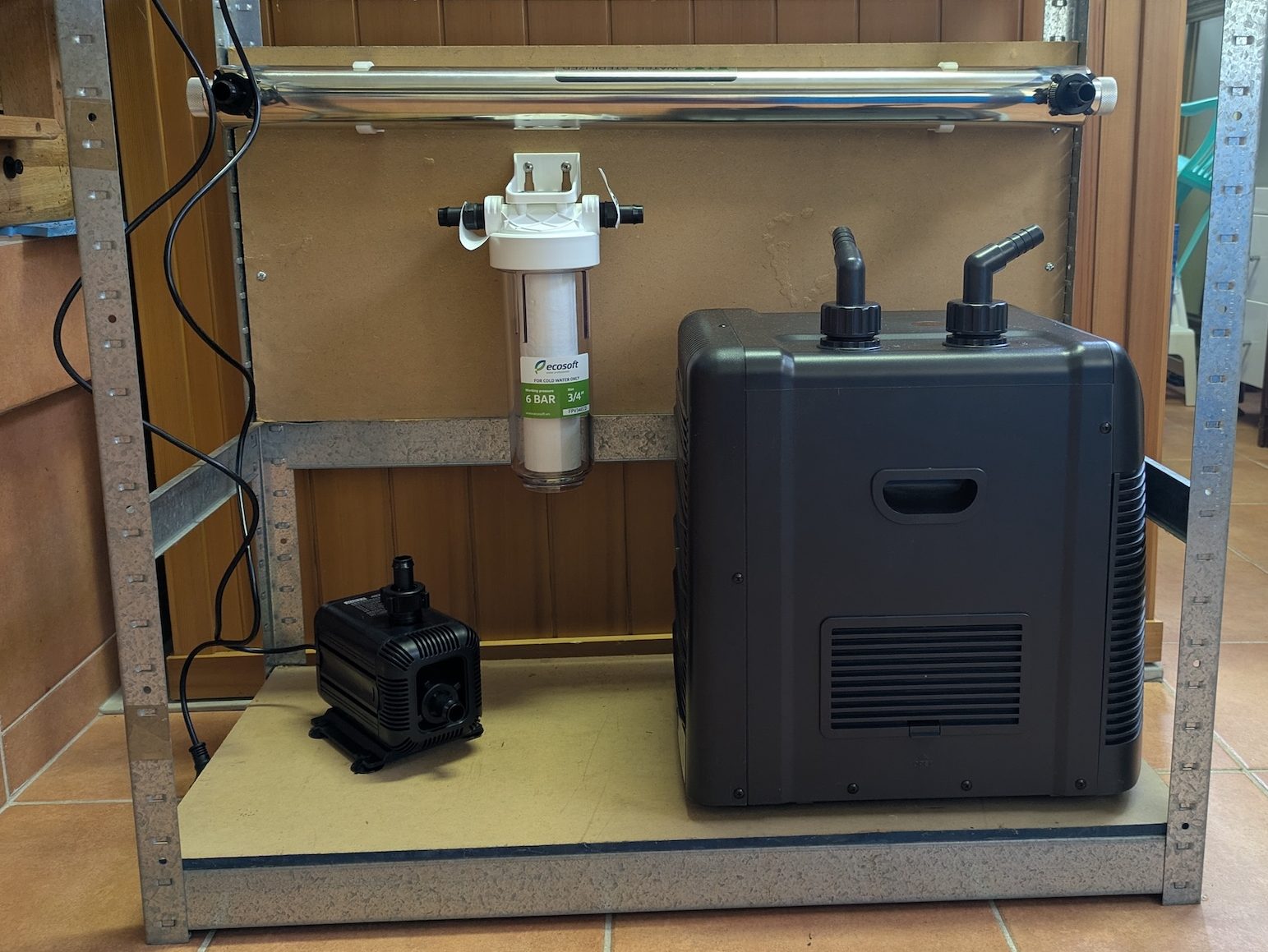


The INSUL8 approach:
- Techniice 400L insulated rotomoulded tub (designed for ice retention)
- External Hailea HC-300A chiller (1/4 HP, 240V Australian standard)
- Hailea HX-6540 circulation pump
- 35W UV-C steriliser for primary water sanitisation
- Ecosoft 10″ mechanical filtration
- Food-grade hydrogen peroxide (H₂O₂) at 30–50 ppm for residual water protection between circulation cycles
Total build cost: $2,340 AUD (full breakdown available in the complete 106-page build manual)
The water treatment approach uses no chlorine and no bromine. UV-C handles microbial kill during circulation, while food-grade hydrogen peroxide provides residual protection when the system is off. H₂O₂ breaks down into water and oxygen — no chemical smell, no skin irritation, no pH balancing.
Chest Freezer vs Cold Plunge Tub: Performance Comparison
Heat Retention
The INSUL8 system maintains 1.5°C heat gain per 24 hours (measured over 6+ months with temperature logging). This is the key metric that determines how hard your chiller works and how much energy you consume.
Chest freezers typically show higher heat gain rates due to thinner insulation designed for air cooling rather than water mass, though published measured data from chest freezer conversions is scarce. The insulation in a chest freezer is optimised for keeping frozen air cold, not for managing the thermal mass of 400L of water.
Energy Consumption
INSUL8 measured data:
- Daily consumption: 0.86 kWh/day (under original 2-hour single-cycle schedule)
- Chiller runtime: 2 hours/day (currently transitioning to a 3–3.5 hour split-cycle schedule for improved water quality — energy data being measured)
- Annual electricity cost: $89 AUD (at $0.285/kWh, original schedule)
Chest freezer energy consumption varies widely depending on model, ambient temperature, and how often the compressor cycles. Freezer compressors are designed for intermittent operation (door opened occasionally for food access), not continuous thermal load management from a large water mass. In warmer Australian states, compressors may run almost continuously during summer.
Water Quality and Maintenance
INSUL8 (low-chemical system):
- UV-C sterilisation kills bacteria during circulation cycles
- Food-grade hydrogen peroxide (30–50 ppm) provides residual protection between cycles
- Mechanical filtration removes particles and organic matter
- Water changes every 3–6 weeks depending on season and usage
- Estimated annual consumables: $400/year (filter cartridges, Hydrogen Peroxide, UV bulb, test strips)
Chest freezer setups typically require chlorine or bromine treatment since most conversions don’t include UV sterilisation or space for inline filtration. This means ongoing chemical smell, pH monitoring, and more frequent water changes. Water change frequency varies from weekly to monthly depending on the sanitation approach and usage intensity.
Lifespan and Reliability
Chest freezer compressors are rated for food storage duty cycles, not continuous operation maintaining water temperature. Users in online forums and Reddit communities frequently report compressor issues at the 2–4 year mark, though reliable failure rate data doesn’t exist.
Purpose-built aquarium chillers like the Hailea HC-300A are designed for continuous operation and commonly last 5–10 years with basic maintenance.
Australian-Specific Considerations
Climate Impact
Queensland and Northern NSW summer temperatures (35°C+) create substantial challenges for any cold plunge system. The chest freezer compressor works hardest in these conditions, while even well-insulated purpose-built systems see increased chiller runtime.
In hot climates, chest freezer users in online communities commonly report:
- Difficulty reaching target temperatures below 12–15°C
- Compressor overheating and thermal shutdown
- Significantly higher electricity consumption
Southern states (VIC, TAS, SA) are more forgiving for both approaches, with lower ambient temperatures reducing the thermal load on any cooling system.
Parts Sourcing
Chest freezers: Available at Harvey Norman, The Good Guys, Bunnings. Easy to source, immediate availability.
Purpose-built components: Insulated tubs from eBay Australia or camping suppliers, aquarium chillers from specialist aquarium stores or eBay. Expect 7–14 day delivery for major components. Plumbing parts readily available at Bunnings.
Electrical Compliance
Both approaches require licensed electrician involvement for legal compliance in Australia:
- Chest freezer: External controller wiring, safety shutdown switches
- Purpose-built: Outdoor GPO installation with RCD protection (if permanent installation)
Cost: $200–$400 AUD for an electrician visit in either case.
Chest Freezer Cold Plunge Pros and Cons
Advantages
- Lower initial cost ($1,200–$1,800 vs $2,340 for purpose-built)
- Widely available components (any appliance store)
- Large online community with shared knowledge
- Familiar technology (everyone understands how freezers work)
Disadvantages
- Waterproofing requires ongoing maintenance and monitoring
- Must unplug before every use (240V electrocution risk)
- Looks like a chest freezer (aesthetic limitation)
- Compressor not designed for continuous water cooling duty
- Temperature control less precise than dedicated chillers
- Usually requires chlorine or bromine water treatment (chemical smell, pH balancing)
Purpose-Built System Pros and Cons
Advantages
- All electrical components external to tub (no unplug-before-use required)
- No chlorine or bromine — UV sterilisation + food-grade Hydrogen Peroxide (breaks down to water and oxygen)
- Measured, predictable performance (1.5°C/day heat gain documented)
- Chiller purpose-designed for continuous water cooling operation
- No waterproofing maintenance required
- Better temperature stability (±0.5°C with digital thermostat)
- Every component individually replaceable without rebuilding the system
Disadvantages
- Higher initial cost ($2,340 vs $1,200–$1,800)
- More assembly required (8–12 hours over 1–2 weekends vs 4–6 hours)
- Larger footprint (separate tub + equipment frame)
- Components less familiar (aquarium chiller, UV steriliser, bulkhead fittings)
Total Cost of Ownership: 5-Year Comparison
Chest freezer cold plunge:
Chest freezer 5-year costs are difficult to calculate accurately because maintenance, repair, and replacement intervals vary widely between builds. What’s clear is that the lower initial cost is partially offset by higher energy consumption (compressor working harder with less insulation), waterproofing maintenance, potential compressor replacement at 2–4 years, and ongoing chemical treatment costs. Total 5-year cost likely falls in the $3,000–$5,000+ range depending on how many issues arise.
Purpose-built INSUL8:
- Initial build: $2,340 AUD
- Annual operating costs: estimated $400 AUD/year (electricity, filters, UV bulb, food-grade hydrogen peroxide, test strips, water). Exact figures being measured under current protocol.
- No major component replacements expected in first 5 years
- 5-year estimated total: $4,340 AUD
The initial cost gap of $500–$1,100 narrows substantially over 5 years once ongoing costs are factored in. For chest freezer builds that experience compressor failure or major waterproofing issues, the purpose-built system becomes the cheaper option over time.
Which Approach Makes More Sense?
The chest freezer cold plunge approach works for people who:
- Are extremely budget-constrained (every dollar of upfront cost matters)
- Don’t mind the unplug-before-use safety protocol
- Are comfortable with ongoing maintenance and troubleshooting
- Live in southern Australia (cooler ambient temperatures reduce compressor strain)
The purpose-built insulated approach works for people who:
- Want measured, documented performance they can verify
- Prefer no chlorine or bromine in their water
- Value set-and-forget reliability over initial cost savings
- Have space for a slightly larger footprint (tub + external equipment frame)
- Want the safest possible electrical setup (all components external to tub)
The chest freezer cold plunge approach saves $500–$1,000 upfront. The purpose-built approach costs more initially but delivers measured performance (1.5°C/day heat gain), safer electrical design (all components external to the tub), and lower ongoing maintenance. Over 5 years, the total cost gap narrows significantly once you factor in chest freezer energy costs, waterproofing maintenance, and potential compressor replacement.
For builders in Australia — particularly in warmer states — the 240V electrical safety consideration alone makes purpose-built systems worth serious consideration.
Want the EXACT PARTS LIST with Australian suppliers and pricing? Download it free →